Iolanda Bianchi
Iolanda Bianchi (PhD in Political Science and PhD in Urban Planning) is an urban and political sociologist. She works in the field of urban governance, policy and collective action. Her research focuses on the role of cities as agents of transformation; on progressive urban and territorial policies, including housing, water management, and culture; on the management and democratisation of local public services; on the governance of urban public land and assets; and on the commons as a transformative form of governance. She currently holds a Ramón y Cajal Research Fellowship (tenure-track) at the University of Barcelona. Previously, she was a Marie Skłodowska-Curie fellow at the University of Antwerp and a Juan de la Cierva fellow at the Autonomous University of Barcelona.
Research areas: urban democracy, progressive urban politics, policy, and service management, urban collective action. Research topics: new municipalism, urban commons, public-common partnerships, co-production of public policies, public asset and land governance.
Bianchi, I. (2024). The democratising capacity of new municipalism: beyond direct democracy in public–common partnerships. Policy & Politics (published online ahead of print 2024). https://doi.org/10.1332/03055736Y2024D000000033 [Q1 SJR, Sociology and political science]
Bianchi, I. (2023). The commonification of the public under new municipalism: Commons–state institutions in Naples and Barcelona. Urban Studies, 60(11), 2116-2132. https://doi.org/10.1177/00420980221101460 [Q1 SJR, Urban studies] Link to postprint version
News
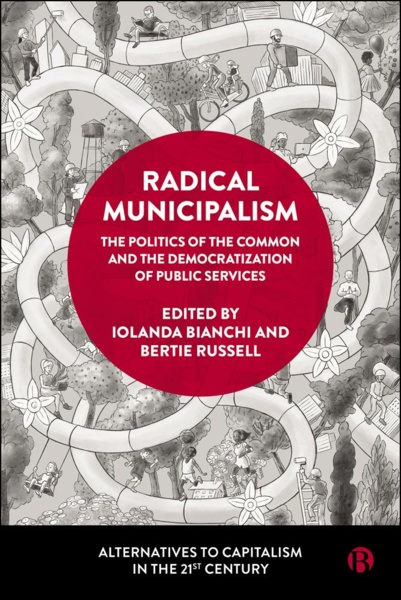
I am happy to announce the publication of the book Radical Municipalism: The Politics of the Common and the Democratization of Public Services, co-edited with Bertie Russell and published by Bristol University Press on 26 February 2026. The volume brings together a strong theoretical framework and 14 original case studies from Europe and the Americas to explore the transformative potential of the politics of the common in the democratization of public services. By examining both the challenges and the possibilities of common-based strategies, the book offers new insights into how local initiatives can foster broader processes of social and political change. It contributes to ongoing debates on the democratic road to socialism as a possible alternative to capitalism and aims to serve as a resource for scholars, practitioners and activists interested in radical municipalism and democratic transformation.

